A curated list of fingerloop braiding resources
other fiber artsI'm primarily a rigid heddle weaver, but fingerloop braiding is a craft I like to do when I want just a tiny little project. It's low stakes and quick to do a short braid. Most of my braids have just been samples and practice using leftover odds and ends of yarn from weaving, and I use them when I need a little something to tie things together, but I have done a few for specific purposes, like a belt for a dress and a strap for my yoga mat.
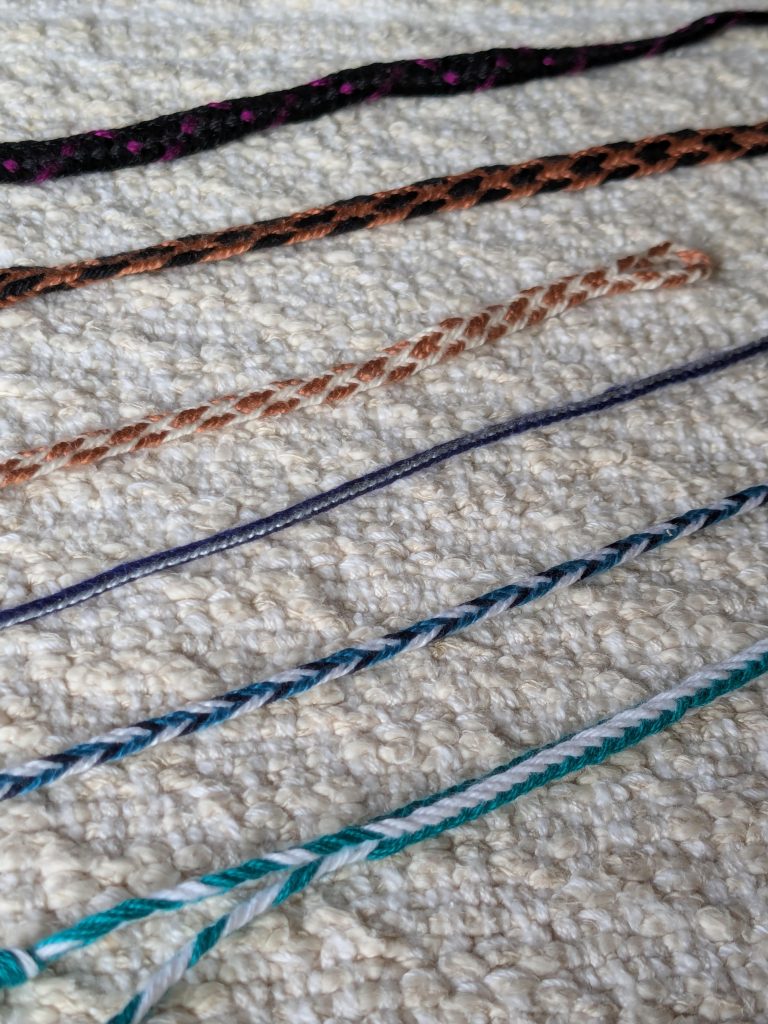
If you can’t learn in person, the best thing is to watch some videos - it’s really hard to describe the hand movements with text and still images! I’m not going to try and describe how to do different braids here, just link to resources that I have found helpful, along with some tips for translating between them.
Fingerloop braiding is a family of braiding techniques where you manipulate loops of yarn on your fingers. Also called Finger Loop Braiding, it falls into a slightly bigger category which includes other loop manipulated braiding techniques where the loops are held on the wrists. I wrote about differences between braiding and weaving back in 2023 - that was when I first started exploring braiding and found I really like fingerloop when I want to be engaged in a quick project and kumihimo on a disk when I want something to pick up and put down. I’ve now taught a class at my weaving guild and am preparing for another - this list is an expanded version of some references I put in my handout!
There is not a ton of information around about this craft online or in books, but it's been practiced in many places all over the world for probably thousands of years. Much of the information comes from folks interested in historical costuming, especially those involved with the Society for Creative Anachronism (SCA), and there are a number of surviving medieval and renaissance manuscripts describing techniques, many of which have samples sewn in.
Tips to help understand resources from different sources #
These are the sorts of things that confused me when going from one source to another, or, early on, when I’d learned one technique and came and found a different tutorial a while later and was surprised when I got different results!
- There’s 3 main sets of techniques for fingerloop where one finger goes through some loops and picks up another loop. Trying to read written instructions for one when you’ve learned another can be confusing, as can trying to apply a colour pattern as the order can be different.
- Method 1: A-Fell. Hands facing each other or up; typically uses the index finger to go through loops on the same hand, then picks up a loop on the other hand. Moves thread inside out.
- Method 2: V-Fell. Hands facing each other or up; typically uses the ring or pinky finger to go through loops on the other hand. Moves threads outside in.
- Method 3: Slentre uses the index finger to go through loops on the opposite hand, Moves threads outside in, but the order is different from V-Fell.
- There’s also the “loop exchange” technique that’s a bit different from above, where two loops on opposite hands swap. This produces a spiral and can be used on it’s own or combined with one of the above techniques (though I’ve mainly seen this with A-Fell).
- Some instructions just refer to braids by the number of loops, or, perhaps, “5 loop flat braid”. There’s many braids possible with a given number of loops and at least 2 that I’ve seen called flat. There’s a lot of different names for braids out there and it can be confusing to figure out which braids are the same, or the same but A vs V fell, etc.
- Similar moves can turn out fundamentally different braids with one difference: was the loop turned over while moving it between hands (often called “reversed” or “flipped”). Some people will simply say “take it from the top” or “from the bottom” but it also matters how your finger grabs it - if you aren’t getting the braid you expect try doing the opposite, or very closely look at how their finger grabs it in a video.
- Read the intro of a source even if you don’t think you need the basics! Different sources use different shorthand notations and/or diagrams, or don’t use one at all, and some use archaic terms based on Middle English, but it’s usually explained somewhere!
- If the source has multiple braids, starting with a simpler braid and/or one you’re familiar with is helpful.
- Write a pattern down in your preferred notation before trying to tackle a new pattern; I find shorthand easier to follow while braiding than written text.
- There’s a few different ways to set up the braids to start - you can cut individual loops, or make one long continuous bundle. For learning a braid pattern it doesn’t really matter: You need loops of very close to the same length secured to something for tension; but for some things like making a loop start or some techniques for long braids it does.
- Videos and photos often show braiding over a table with the clamp at the far end because it makes for a cleaner background on camera. Usually I have a clamp on the edge close to me and the braid forming in the air between the table and my body.
Resources #
Online Resources #
I’m focusing on folks who go beyond the most basic braids or have some particularly interesting techniques - there are a number of sources who only go over a couple basic braids. Broadly speaking the most comprehensive and beginner friendly resources are higher on this list.
Loopbraider: (Ingrid Crickmore) This is probably the single most comprehensive source on loop braiding from a range of especially non-European cultural backgrounds along with modern inventions. Mostly V-Fell instructions - she focuses on areas not well covered by others. Beginners check out her “Start Here!” tutorial. Her YouTube videos are designed to go along with her written tutorials.
Fingerloop.org: SCA focused site with transcriptions of manuscripts and pictures of samples for many braids. A-Fell methods. Ordered in roughly ascending difficulty. See the Basic Braiding Instructions and the Braid Patterns pages; there's one or two videos that accompany it. I believe this is a slightly expanded version of a booklet published through the SCA.
Silkewerk.com - Fingerloop Braids: (Cindy Myers) Transcriptions of manuscripts, A-Fell methods. A lot of overlap with Fingerloop.org but organized and explained a bit differently and has more complex braids. Some braid instructions are missing but may be accessible via the Wayback Machine:
Sue Lamberton The Silkewoman: has a tutorial series on YouTube covering set up, several Fingerloop braids using A-Fell techniques, and ends with “Two methods for making Extra Long Braids”. These videos should be pretty complementary with the mostly written Fingerloop.org and Silkework.com patterns above.
Finger Loop Braids by Deorwine aet Earneleia: The webpage has some lovely samples of mostly fingerloop braids, but scroll down to the Documents section for both a class handout and 70+ page PDF e-book! This has some V-Fell style variants of braids from European Manuscripts, plus some interesting set up and finishing techniques, and lots of images of techniques and colour patterns.
Fingerloop Braiding for Beginners: This is another tutorial that has a small selection of braids, but includes a couple more unusual ones, like the Condark Lace Departed! Uses a fairly different pattern notation.
Kute Uchi Revival: this focuses on “Kute Uchi”, a Japanese style of wrist held loop braiding but also has some fingerloop materials and discussions of how they differ. Holding loops on your wrists allows for some different patterns but it’s harder to keep the loops in order.
The Creative Contessa: Historical costumer with some videos on braiding, and things like sewing braids into clothing, 2 person braids, etc. I love this short on a of dealing with a very long braid using your foot. She does a lot of livestreams some of which feature braiding, and her in depth focused tutorials are paid classes.
Morgan Donner: has a good tutorial on "A Grene Dorge of VI Bowes" c. 1475” which is a great braid to try after you’ve learned the basics (it combines A-Fell and Loop Exchange). Her other “Easy Fingerloop Braid” video shows the “palms down” (slentre) technique.
Fran Caselli - Andean Braid: YouTube video which shows a method of making a braided fringe on a woven scarf, wrapping it, and turning the ends into a fluffy tassel – She uses a fingerloop technique that produces a doubled 5 strand braid by going over all of the loops. This kind of braid (which could be made with many braiding techniques) often doesn't get shown in fingerloop sources! It's also got a great way of anchoring down a scarf which can be used for fringe twisting as well.
Lady Alheydis's Boke of Secrets: Written descriptions of 4 braids combining elements of medieval braids in different ways - an SCA project which also included making a medieval style manuscript. 2 of them are fairly straightforward braids while the other 2 are complex 2 braider braids.
The Snake Said to the River: I've linked to her video on "Lace Cheveron Broad" which is an 8 loop flat braid, she has another featuring more basic A-Fell braids. She also shows wrapping to make a tassel finish.
Teffania's Stuff: has a few blog posts on some concepts in Fingerloop (I linked to the one on Reversed vs Unreversed above), including a great one on how to teach it.
Books #
There’s no books that I’m aware of that are an “easy” introduction for a beginner. Some historical costuming books may have instructions for a braid or two as well. I have not actually seen any of these books.
Fiber Craft Heritage: Doris Fischer. 2025. This is a more general book that has a chapter that looks to cover some basic Fingerloop braids.
Tak V Bowes Departed: Gina Barrett & Elizabeth Benns. This book focuses on a specific medieval manuscript which has 40 braid patterns.
The Manual of Braiding: Noémi Speiser. This is perhaps the most comprehensive book on braiding in general. It goes well beyond just fingerloop but Speiser was extremely knowledgeable on fingerloop braids and interpreting medieval manuscripts. Originally self-published in the 80's it's currently in print by a Swiss publisher but not widely distributed.
Groups #
The Braid Society: UK based organization, there’s a rate for “long distance” memberships.
Advanced Resources #
These resources go way beyond beginner level for those who have learned the basics and really want a deep dive.
L-M BRIC News (L-M Braiding Research & Information Center): This was a series of newsletters published from 1998-2010 by Masako Kinoshita. It has various reports of loop manipulation techniques used around the world, often with instructions. It especially focuses on documenting traditional techniques. The original website is down, but you can access it via the Wayback Machine, or, loopbraiding.com has a backup (often scanned printouts) maintained by her daughter June.
Old English Pattern Books for Loop Braiding: Noémi Speiser. Out of print.
European Loop Braiding (Parts 1-4): Noémi Speiser and Joy Boutrop - digital versions available free via spranglady.com
Materials #
I often use leftover bits from weaving - thrums are great for learning and sampling, and those bits left on the shuttle for longer braids! If you need to purchase yarn, cotton embroidery floss or craft cord is readily available in small quantities in a range of colours and works well, as does crochet thread (e.g. size 3 to 10). I have found that I really like the look and feel of 5/2 mercerized cotton that I've bought for weaving; DMC's #5 Pearl Cotton embroidery thread is interchangeable and comes in a wide colour range and reasonable lengths for braiding. But I've braided everything from thick knitting yarns to sewing thread.
Check out Not So Rigid Designer, the online weaving software for rigid heddle loom weavers!