Heddle size vs sett on rigid heddle looms
planning projectsNot So Rigid DesignerHeddle Size Vs Sett #
On rigid heddle looms, we often think of heddle size and sett as the same thing, but this isn’t always the case. This difference is important when we get into more complex threadings.
The heddle size is measured in Dents Per Inch (DPI), or dents per 10cm (often written like 40/10 for 40 ends per 10 cm). This is a property of the heddle; for example, a 10 DPI heddle or a 40/10 heddle. The sett is measured in Ends Per Inch (EPI), or ends per 10cm, and is how many threads there actually are per inch or 10cm at the heddle, and is a property of the warp. We can also count ends per inch in the finished fabric, which will generally be a bit higher due to draw in and shrinking during wet finishing.
The most common case in rigid heddle weaving, where you have one thread in each hole in slot, can be called a density of 100% - the heddle size and sett are the same; a 100% density threading in a 10 DPI heddle is a set of 10 EPI. This is used for plain weave and many common pick up patterns.
Another very common case is a density of 200%. You get 200% density when you “double the ends”, in a single heddle, where you pull a loop through each hole and slot while direct warping, or, you can set up with 2 heddles for a double density plain weave or a variety of other structures, as in the standard two-heddle threading. In these cases, the sett is twice the heddle size - a 200% density threading in a 10 DPI heddle would be a sett of 20 EPI. You could also skip every 2nd hole or slot to make a 50% density threading, perhaps for a weft faced weave; a 50% density in a 10 DPI heddle would be a sett of 5 EPI.
Lots of other densities are possible when we get out of having the same number of threads in each hole and slot, like when converting shaft loom patterns to rigid heddle. In these cases, there's often a few different reasonable options that cram multiple threads in some spaces or skip some. For example, with Krokbragd or other 3 shaft twills you often end up with choices of threading like 66.7% where you skip every 3rd heddle position, for a set of 6.67 EPI in a 10 DPI heddle, or, a more dense position where you double up some positions, for 133% density, or 13.3 EPI in a 10 DPI heddle.
I’ve recently added a Sett Calculations feature on the Threading Diagrams in Not So Rigid Designer to help calculate the final EPI and width of the design in a given heddle size while choosing threading options. This lets you quickly explore lots of different sett options to come up with the one most suitable for your yarn. The width output will be in inches if you enter a heddle size in DPI (e.g. 8 DPI) and cm if you enter the heddle size in dents per 10cm (e.g. 40, for a 40/10 heddle). This is currently in preview for Premium users but will come to all users soon!
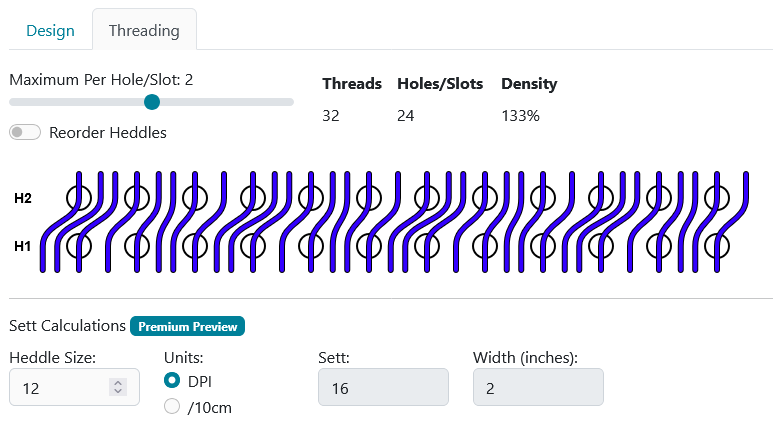
But to understand those calculations better, or do them on your own, to go from the heddle size to the final sett, you need to multiply the heddle size by the density. If it’s 100%, that doesn’t change anything! Remember when multiplying by a percentage to divide by 100 (unless your spreadsheet knows it’s a percentage!). So a 133% density threading in a 12 DPI heddle is 12 * 1.33 for a sett of 15.96 EPI (or rounded to 16 EPI!).
To go from sett to width (at the heddle), you multiply the sett by the number of threads. If you're working in ends per 10cm then you would also need to divide by 10 to get the result in cm. Some brands of heddles are labelled in both DPI and dents per 10cm. These will typically give a more accurate value using the dents per 10cm figure as the DPI figure is rounded, though you can measure your heddles to be sure.
You also need to figure out what sett is suitable for your project, but that's a whole other topic! In short, any given yarn and structure has a reasonable range of sett from a very loose to very dense fabric - you can look at my Ashenhurst Sett Calculator or various sett charts to figure out a reasonable sett range for the yarn you intend to use.
One other thing that rigid heddle weavers come across is something called a reed substitution chart. These charts are made for looms where the heddle and reeds are distinct, and you can use a different size reed with limited impact on the final piece. However, on a rigid heddle loom, the heddles and reed are combined into one piece, so if you start trying to follow a chart you’ll end up with a different texture. This may be an interesting design feature; one of my favourite pieces uses a mix of doubled and singled ends to make some thicker coloured stripes pop, and periodic doubled ends can add some texture interest, but it will much more dramatically affect the end result and might not give the result you’re looking for; and in some cases might end up with something totally unweaveable if too many slot or hole threads are skipped.
We have fewer options to play with sett than on a shaft loom, but that doesn’t mean there are no options! Happy weaving!
Check out Not So Rigid Designer, the online weaving software for rigid heddle loom weavers!